This is the sermon I preached at Community Church of Sebastopol in November. I have also included a link to YouTube if you would like to watch: https://www.youtube.com/live/30wE7DOjPjA?si=4bus1judctyscxst
Our scripture reading today is from:
Jeremiah 23:1–6
1 Woe to the shepherds who destroy and scatter the sheep of my pasture! says the Lord.
2 Therefore thus says the Lord, the God of Israel, concerning the shepherds who shepherd my people: It is you who have scattered my flock and have driven them away, and you have not attended to them. So I will attend to you for your evil doings, says the Lord.
3 Then I myself will gather the remnant of my flock out of all the lands where I have driven them, and I will bring them back to their fold; they shall be fruitful and multiply.
4 I will raise up shepherds over them who will shepherd them, and they shall not fear any longer or be dismayed, nor shall any be missing, says the Lord.
5 The days are surely coming, says the Lord, when I will raise up for David a righteous Branch, and he shall reign as king and deal wisely,
and shall execute justice and righteousness in the land.
6 In his days Judah will be saved and Israel will live in safety. And this is the name by which he will be called: “The Lord is our righteousness.”
“May these words settle into our hearts and guide our steps in love. Amen.”
Friends, beloved ones, family in struggle and grace,
The prophet Jeremiah does not mince words. He shows up like a holy storm cloud and says, “Woe to the shepherds who destroy and scatter the sheep.” WE see here in the reading, He is speaking to leaders who have misused their power, who have let the vulnerable fall, who have traded the nation’s soul for their own security.
In Jeremiah’s day, kings sat on thrones made of conquest and fear, and God looked at those broken systems and said, Enough. I will raise up a shepherd who gathers, not scatters. Who heals, not harms. Who protects, not dominates.
Sometimes our sacred story feels painfully relevant now.
We see leaders acting like kings, asking to be worshiped, grasping at power like a child with fists full of wet sand. We hear chants of “strongmen” in our politics, see violence stoked like a bonfire, and watch those who claim greatness trample people experiencing poverty, the immigrant, the trans child, and the sacred earth itself.
Just a month ago, across the globe and in our own streets, ordinary people lifted their voices and signs. Many of you were there in body and Spirit. And together we proclaimed “No Kings Day,” echoing from cities and campuses, a reminder that democracy cannot survive a hunger for crowns. A reminder that we do not kneel before those who demand fear.
Jeremiah speaks into that same dream and that same danger. Truth travels well across centuries.
And it’s interesting to me that we often call Christ the King or speak of the kingdom of heaven.
Today in the church is the Reign of Christ Sunday.
Reign of Christ Sunday was first proclaimed in 1925 by Pope Pius XI, in a world trembling under the rise of fascism. It feels all too familiar now. The church saw nationalism growing like a weed with poisonous fruit. It feels all too familiar now. Leaders were treating themselves as messiahs. Sound familiar?
Reign of Christ Sunday was meant to say something bold,
No earthly ruler gets the final word. No administration owns our allegiance.
The intentions of Christ the King were good. They gave a message of hope that was much needed.
In progressive traditions, like our own, we hold that same heart. But we do not proclaim a king who sits high and unreachable. We proclaim a Christ who kneels to wash feet. Who marches with the oppressed. Who hangs on the cross that empire built and whispers resurrection anyway.
This is not the reign of domination.
It is the reign of liberation.
Christ does not seize the throne. Christ flips it into a table where everyone belongs.
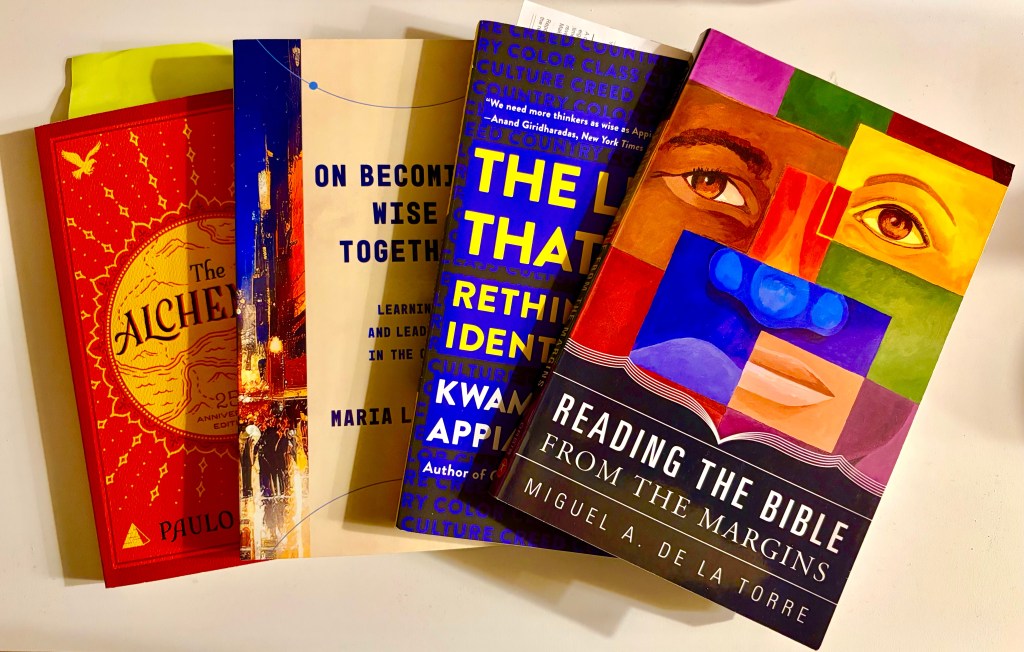
Miguel de la Torre, an ethicist and theologian, writes passion into his book Reading the Bible from the Margins, allowing seekers to understand the Bible when they might not fit into what the current administration deems as “good.” He reminds us that Scripture has always been interpreted most faithfully by those whose bodies and futures are at stake, not by those in palaces, but by those pushed to the edges. When we read Jeremiah from the margins, we remember that God’s heart is not neutral. God’s justice is not polite. Recovery of the oppressed is not a side quest; it is a primary objective. It is the plot.
He teaches us to read like the hungry look for bread. To notice who suffers when leaders fail. To join God not just in worship, but in disruption. Disruption is the theology of a Christ-like life.
Jeremiah is not whispering comfort for the powerful.
He is announcing consequences for cruelty.
He is calling shepherds back to tenderness, or calling them out entirely.
What does that look like for us in the church now? Here in this church, in this neighborhood, in this nation aching under the weight of white nationalism and rising authoritarianism, we call it out. We stand with God and with all of humanity. We call out:
No kings.
No tyrants.
No “strongman saviors.”
No closets for our queer beloveds.
No cages for immigrants.
No erasure of the poor.
No silencing the voice of the Spirit from the mouths of the vulnerable.
We follow the One who traded a throne for a manger, a crown for a circle of friends, and a weapon for open hands.
And when we call this out, that changes how we live.
We do not, and we cannot wait for heaven to do the work.
We build glimpses of God’s reign in the present moment.
We show up for trans kids.
We feed families without asking how they earned it, without asking about their membership status.
We say the names of those killed by state violence, and we do not let their memory fade into statistics.
We hold one another like the world might break, and then we bake pies, provide showers, put together Christmas boxes, and importantly we hold signs and tell the truth anyway.
Because Love is not passive.
Hope is not pretending everything is fine. Hope is the quiet fire that refuses to be put out. Hope is tying our future to the ones most harmed and saying, We rise together or not at all.
Hope is believing God is not done dreaming.
Let me tell you a story from seminary, specifically, Zoom seminary, which is its own genre of spiritual warfare. I am wrapping up the last few weeks at Pacific School of Religion in Berkley, and some of my classes each week I attend over Zoom from my home office.
So, it’s a Thursday morning, 9:40 a.m., and our class is gathering on Zoom. You know how it is, a scar of a memory from the early days of COVID: half the faces are squares with initials, someone’s mic is unmuted, and we hear a blender in the background, and our professor is trying valiantly to share their screen, but instead, technology continues to be technology.
Holy mayhem.
I log in feeling… okay-ish. I have my red bull. My notes. My hope for the world at about 40%. We’re settling in when the professor says, “Alright everyone, take a moment to share how your spirit is doing today.”
Which is a trap.
Immediately, the chaos blossoms. One classmate launches into an existential crisis monologue. Another is trying to talk but their Wi-Fi turns every fifth word into a robot prophecy. Someone’s dog is barking. And there’s always that one person whose camera is at an angle that makes it look like they’re broadcasting from inside a laundry basket.
Then the professor calls on me.
I’m about to say something pastoral and studious, something like, “My spirit is feeling reflective today” when another classmate suddenly blurts out:
“I’m just tired of leaders acting like kings. I want a world where people can actually breathe.”
And friends… there it was.
Right in the middle of Zoom chaos, unstable connections, pixelated classmates, the Holy Spirit trying her best to work through lag, someone just drops the truth:
“No kings. Just breath.”
And it struck me. Because that’s the cry of Jeremiah’s heart. That’s the ache of every marginalized person. That’s the dream of Christ’s reign.
Not kings. Not tyrants.
Not leaders who puff themselves up and scatter the flock like Wi-Fi dropping during a prayer.
Just breath.
Just dignity.
Just room to exist without fear.
I sat there on Zoom, watching classmates glitch in and out of existence and I felt the Spirit say:
“Do you see? Even in the messiest spaces, liberation is rising.”
So now when I hear politicians thundering about power, purity, obedience, dominance, anytime someone starts behaving like they’ve been divinely crowned with unquestionable authority. I can think of that classmate on Zoom:
“I want a world where people can breathe.”
And I think:
Yes. Exactly that.
We are building breathing room.
And we get to be part of it. We are not done dreaming.
Not crowned but called.
Not enthroned but empowered.
So when we leave this space today, I challenge you to a proclamation,
There is no king but the Love that liberates.
There is no power higher than justice and equity.
There is no dominion greater than compassion fierce enough to transform us.
May the shepherd who gathers guide our feet.
May we refuse to bow to fear.
May our hearts beat toward a world where every child grows without terror and every soul breathes free.
No kings.
No fascists.
Christ reigns in liberation and disruption.
And that reign is already rising in us.
Amen.


 Seminarian in Searching
Leave a comment