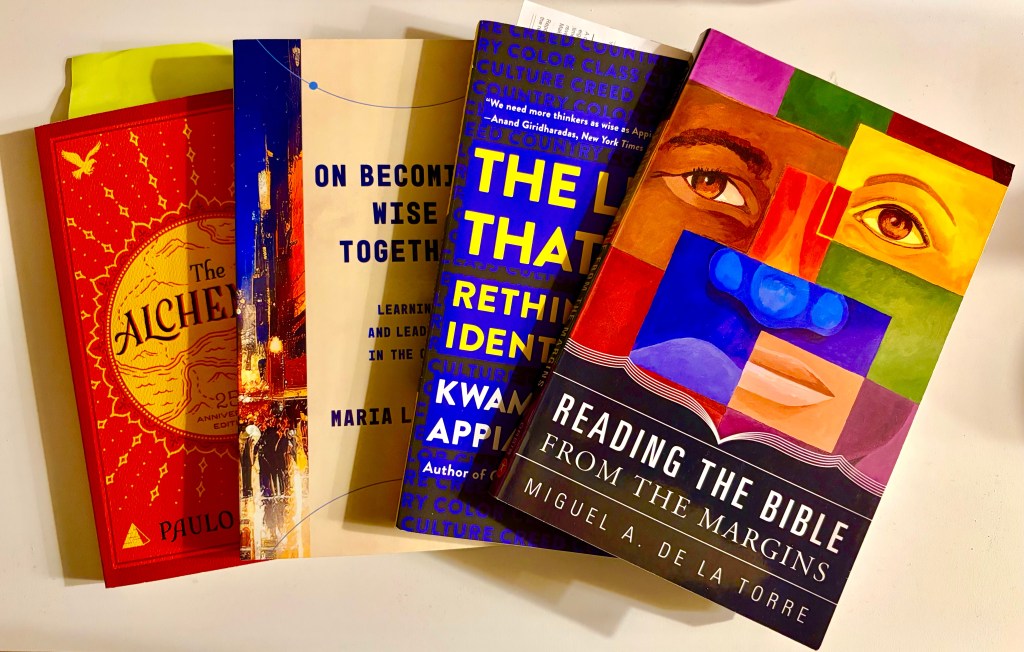
This week at school is “Reading Week.” There are no scheduled classes, which allows students a chance to catch up on any reading or assignments, get a head start on the second half of the semester, and hopefully enjoy some downtime.
For a few weeks now, I have intended to provide a brief overview of Pacific School of Religion from my perspective, and now that I have the chance to step back, this is the perfect opportunity.
*Side Note* After writing these first two paragraphs, I got distracted and still did not finish this until after reading week.
What is PSR?
Pacific School of Religion is located in Berkeley, CA. It was founded in 1866. The founders of PSR intended the seminary to be, in their own words, ― an Institution of the People, a child of the churches. It has always been identified as a Seminary focused on social justice. With an impressive background in advocacy (https://www.psr.edu/about/history/), it was a no-brainer that this would be a good fit for my ministry goals. PSR is also closely connected with the United Church of Christ (UCC), the denomination of which I am seeking Ordination. PSR has a unique blend of asynchronous classes that, so far, have made us feel like we are all in the room together each week, regardless of whether we are attending in person or via Zoom. It also integrates this into its weekly chapel service and several other opportunities it presents to students.
I’ll be doing a more in-depth posting about my switch from Chicago Theological Seminary to PSR, but it has been a great choice that I am glad I made when I did.
Stackable Curriculum
One of the unique aspects of PSR, and something I love for many different reasons, is its stackable curriculum. The Master of Divinity program, in which I am enrolled, prepares students for success and a well-rounded education by offering certification upon completion of each full-time academic year. The first year you complete a Graduate Certificate. There are two options, and I am currently pursuing the Certificate of Sexuality and Religion. At the end of your second year, you are awarded your Master of Arts in Social Transformation. By the end of the third year, you will complete your Master of Divinity, in which I will be pursuing the Chaplaincy concentration.
I have heard from other students that it is a comfort to them to know that each year they accomplish something, even if life gets in the way of finishing all three years together. This feels great for me as someone who struggles with ADHD, loves to plan, and enjoys a good list to check things off! There is some flexibility regarding elective courses and other requirements later on. Still, I really enjoyed that this first year, the classes all provided a solid foundation for the different ways to think about the world as we delve into theological academia.
Fall 2025 Classes
I will provide a breakdown of the classes I’m enrolled in this semester, along with the descriptions provided by the school. My only comment at this time is that I am really enjoying them all. The professors are engaging and genuinely care about the material they present. Almost every class has to be cut off because the conversation doesn’t end. As previously mentioned, I really feel like I’m getting a new foundation for how to think and interact with the world around me.
Rehectorial Use of Text
The purpose of this course is to introduce students to different methods used to interpret texts. Students will learn and develop skills of closely reading texts, analyzing historical and contemporary contexts, and thinking critically through issues. This class will introduce students a wide range of sacred and secular texts. Students will learn to apply rhetorical strategies to construct interpretations that promote inclusivity, social consciousness, social justice, and speak to the current social and political contexts. This is an introductory level course and requires no prerequisite.
Introduction to Christian Ethics
This course introduces students to theories of ethical discernment, behavior, and formation in Christian traditions. The course prioritizes ecological wellbeing as an ethical demand of Christian living and will use case studies about human relationships with our other-than-human kindred to practice the ethical theories studied.
Contextual Thinking
One of the foundational education commitments that undergirds this course is the assertion that all knowledge is contextual. In the various settings of ministry and social transformation, context plays an important role in shaping our work, our approaches to that work, our understandings of our own role in that work, and the meaning we make of it. At its core, this course seeks to ground our theological explorations in a deeper understanding of our own social contexts, as we develop facility in translating from one context to another and engaging across difference. Focusing in particular on the case of race, this course is designed as a path for exploring and understanding the ways that race in all of its intersections operates as a social fiction and lived experience in ourselves and in the communities we serve. Making use of historical, theoretical and theological lenses, we will engage in self exploration, deep formation, readings, dialogue, and experiences with artists and activists as we build our capacity to address issues of prejudice, power, and privilege while cultivating cultural humility and cross-cultural competency.
Spiritual Formation for Leadership
This course offers an opportunity to deepen spiritual life in personal, interpersonal, communal, and cosmic dimensions. It will focus on engaging contemplative practices from across the inter-spiritual tradition as well as study the teachings of mystics, privileging those who lived engaged in the pursuit of collective justice. Participants will have a chance to explore the nature of spiritual formation while discerning which practices, resources, and attitudes are appropriate for sustaining vitality, rootedness, and creativity in their personal life, faith, leadership, academic, and social justice work.
Spring 2025
The class schedule for Spring has just come out, and based on the requirements, this is what I will likely be taking.
- Theological Thinking
- Transformative Leadership
- Embodied Liberation: Theologizing the Body
- Design Thinking for Social Change
- CSR Final Project (A 1.5-unit course where I design and present my own research on a topic of my choice around Religion and Sexuality.)
Love and Community
By the halfway point of my first semester, I am on the right track. I am exhausted, overwhelmed, and my brain often hurts, but it has been so warming to my heart to be here.
So, what would you like to hear? What about this seminary journey would you be interested in knowing more about? I’d love to hear all your thoughts!


 Seminarian in Searching
Leave a comment